
Search Massachusetts Family Court Records
Massachusetts family court records are kept by the Probate and Family Court in each of the state's 14 counties. These records cover divorce, paternity, guardianship, custody, abuse prevention, and other family law matters filed across 351 cities and towns. You can search case information online at no cost or visit your local courthouse to request certified copies of filings, judgments, and other court documents.
Massachusetts Family Court Records Overview
Where to Find Massachusetts Family Court Records
The Massachusetts Probate and Family Court is the primary source for family court records in the state. This is a statewide court system with 14 divisions, one for each county. Each division keeps its own case files and records for every matter filed in that county. The Register of Probate manages records access and handles copy requests from the public within each division.
Massachusetts family courts handle a wide set of civil case types. These include divorce and legal separation, child custody, parenting time, child support, paternity, guardianship of minors and incapacitated adults, conservatorship of finances, adoption, abuse prevention orders, harassment prevention orders, name changes, wills, estates, and equity actions. Every one of these case types creates a court file, and most of these files are open to the public under Massachusetts law.
The official Probate and Family Court homepage lists all 14 divisions with addresses, phone numbers, hours, and direct links to each county location. If you are not sure which county handled a case you are looking for, this is a good first stop.
The Probate and Family Court homepage at mass.gov gives you contact details, location info, and links to each of the 14 county divisions across Massachusetts.
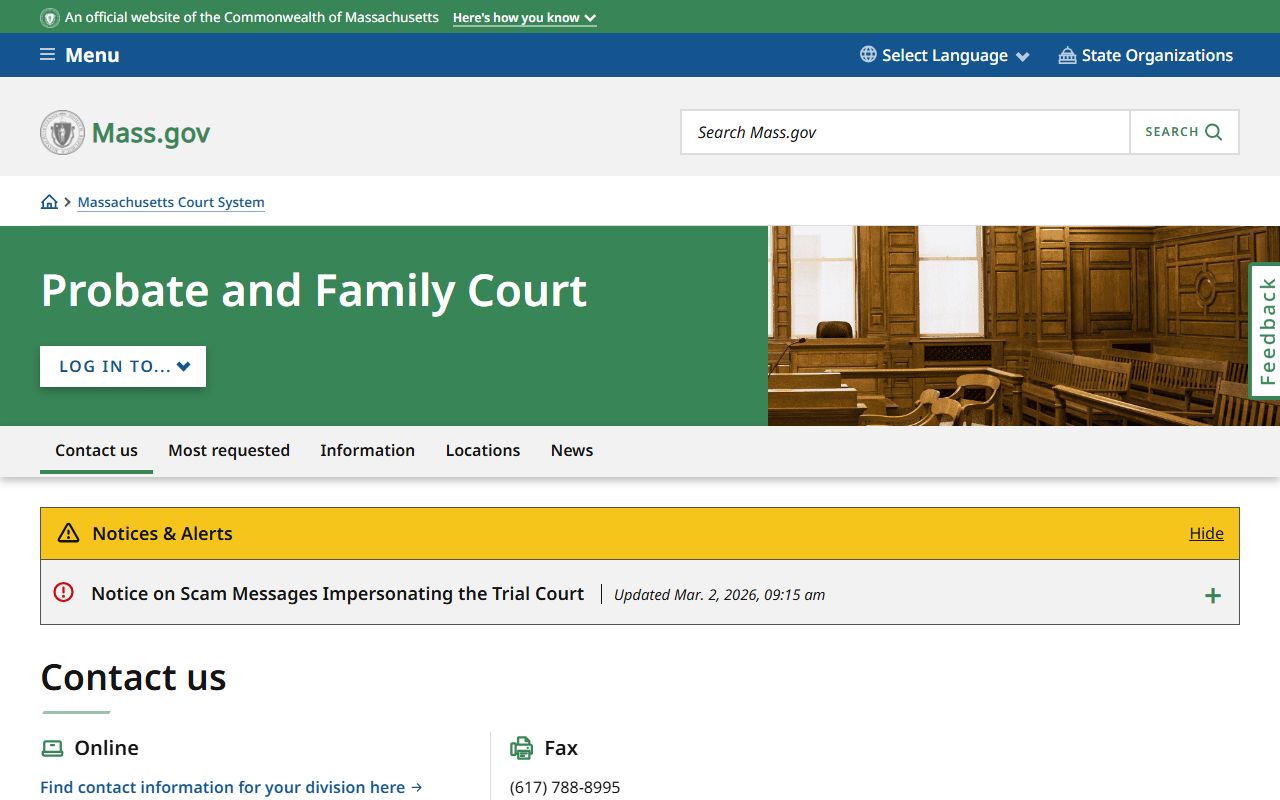
Each county court page on mass.gov includes its specific virtual registry hours, staff contacts, and how to access family court records in person or by mail.
Searching for Family Court Records Online
The MassCourts portal is the state's free online case lookup system. It covers all 14 Probate and Family Court divisions at once. You do not need an account to use it. Case records go back to 2000, and document images are available for matters filed from 2009 forward. Confidential, impounded, and sealed records do not appear in results.
MassCourts at masscourts.org gives free public access to case information across all Massachusetts Probate and Family Court divisions including party names, docket entries, hearing dates, and case status.
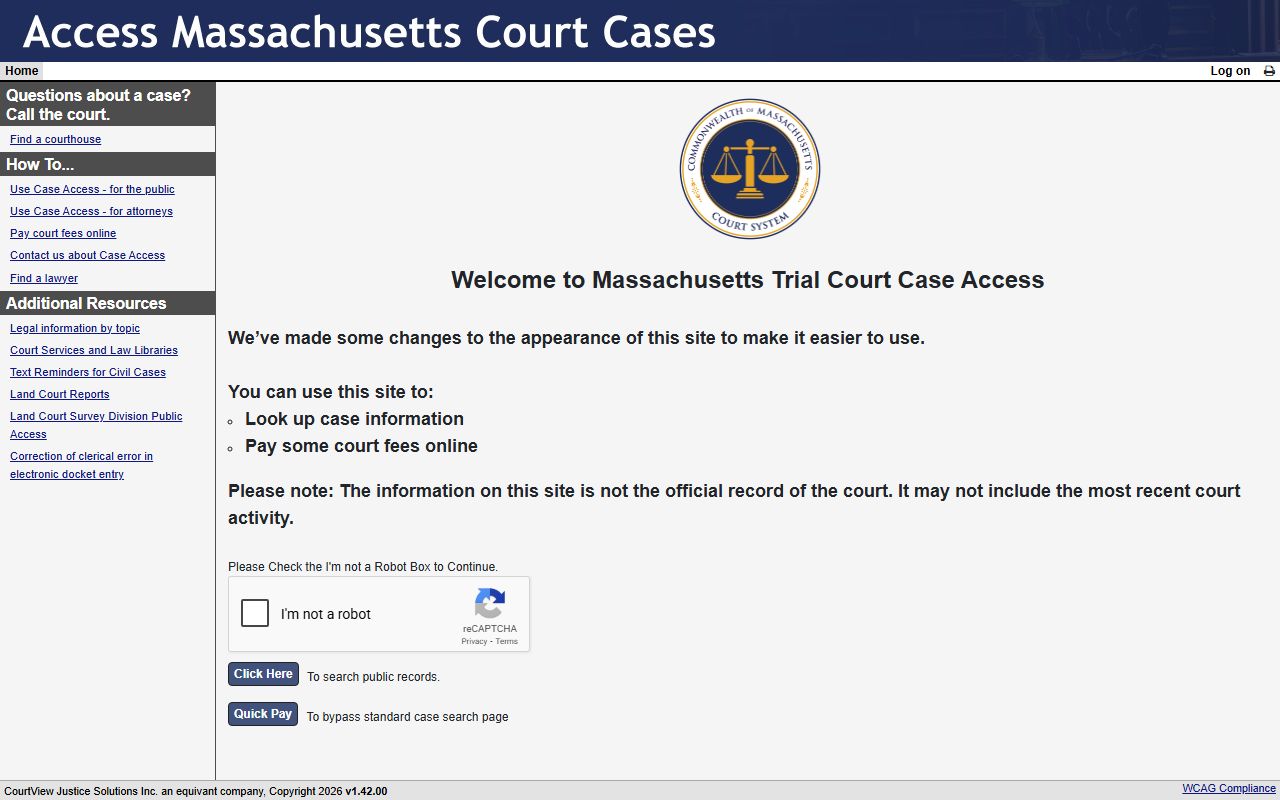
The portal returns party names, case status, docket entries, upcoming hearing dates, and any balance due on the account. Full document downloads are not available through MassCourts.
MassCourts offers four ways to search. The name search works for civil cases and lets you look up by last name (minimum two characters), first name, or company name. Case type search lets you filter by type of matter within a date range, though the range cannot exceed one month at a time. Case number search is the most exact option. For Probate and Family Court cases, the number follows a format like PL14E0125QC, where PL stands for Probate and Family, 14 is the filing year, E is the case group, 0125 is the sequence, and QC is the case type code. A fourth tab covers citation or ticket numbers, which applies only to traffic matters.
For cases not yet in the electronic system, you need to visit the courthouse in person or submit a written request. Records before 2000 often exist only in paper form. The court staff can help you find older files when you know the approximate year and county.
Types of Cases in Massachusetts Probate and Family Court
Divorce cases are among the most searched family court records in Massachusetts. Each divorce file typically contains the complaint or joint petition, a separation agreement, financial statements from both parties, child support worksheets, parenting plans, and the judgment of divorce. Under Chapter 208 of the Massachusetts General Laws, a divorce is not final when the judge signs the order. A waiting period called the nisi period must pass first. For a joint petition filed under Section 1A, the wait is 120 days. For a contested complaint under Section 1B, it is 90 days. Only after that wait does the divorce become absolute.
The Chapter 208 statutes page covers all the rules for divorce in Massachusetts including residency requirements, grounds, property division, and the nisi period.
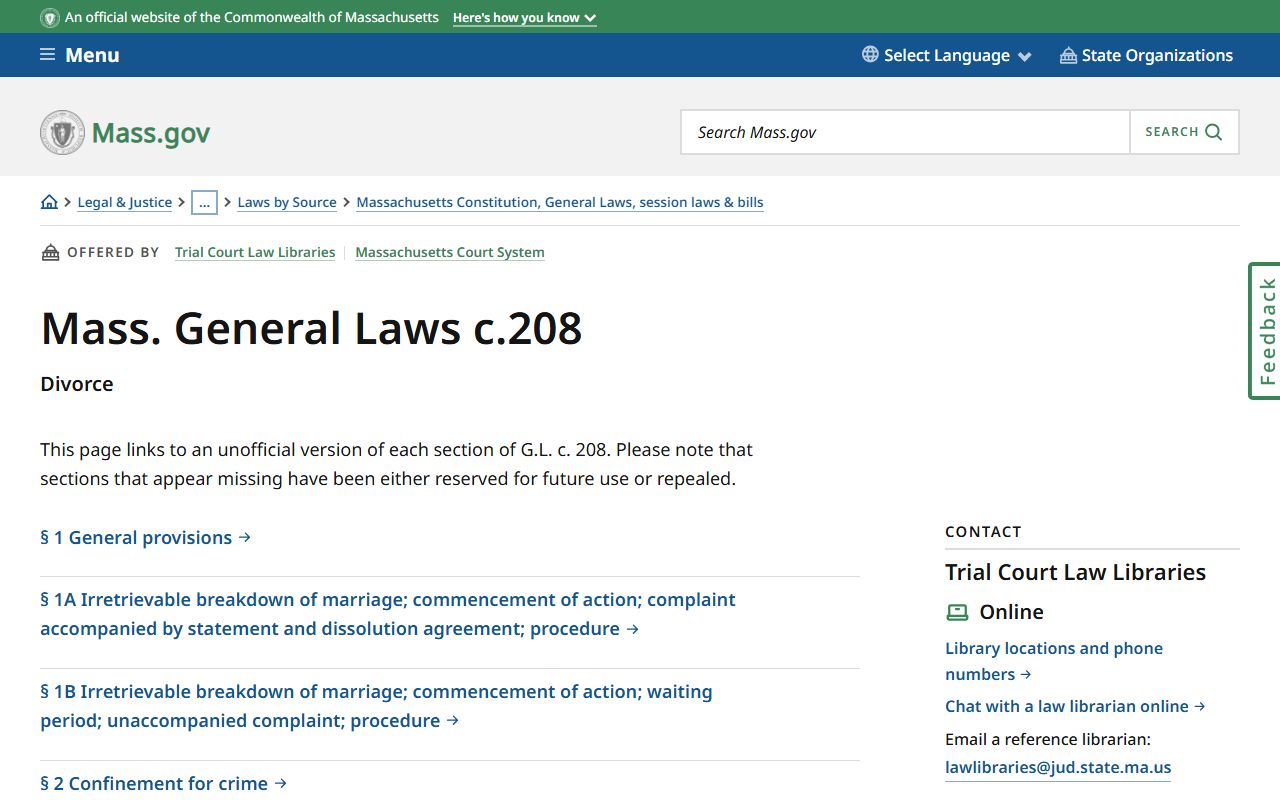
Chapter 208 also governs alimony, child custody, and property division in divorce cases heard by Massachusetts family courts.
Paternity cases fall under Chapter 209C. These records set out the legal relationship between a child and a parent who was not married to the mother at the time of birth. They often include custody orders, visitation schedules, and child support determinations. Guardianship records cover court-appointed decision-makers for minors or adults who cannot manage their own affairs. Conservatorship records address the management of a person's finances when they are not able to do so themselves.
Chapter 209C statutes govern how paternity is established in Massachusetts and what rights and duties follow for each parent once paternity is confirmed by the court.
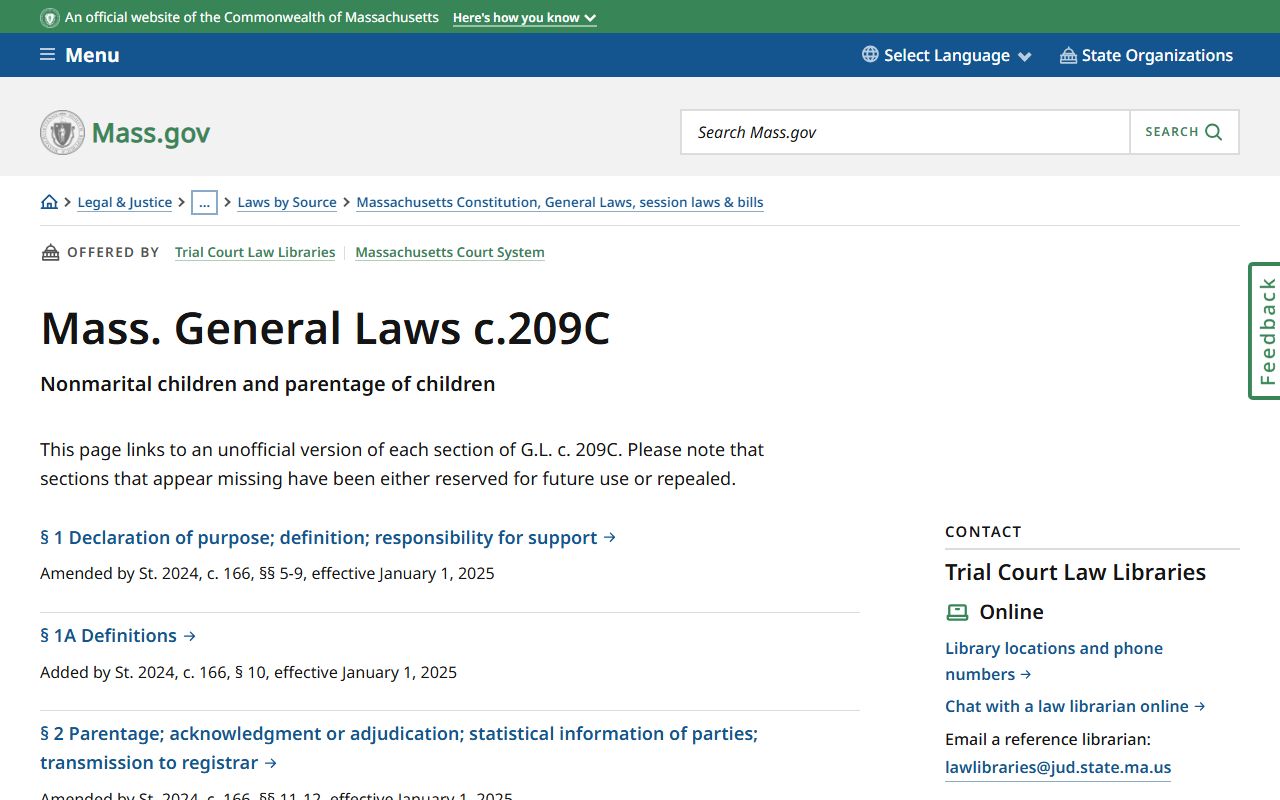
These statutes also address custody and support when parents were not married, making the records filed under Chapter 209C an important part of the broader family court record system.
Abuse prevention orders under Chapter 209A protect victims of domestic abuse by family or household members. As of September 2024, the definition of abuse was expanded to include coercive control. Records from these cases are available in person at the courthouse but are not searchable online. Chapter 258E covers harassment prevention orders for people threatened by non-family members. Both types of protective orders are handled by the Probate and Family Court and create official case records.
Getting Copies of Family Court Records
To get copies of Massachusetts family court records, you have three main options. You can visit the Probate and Family Court in person, send a mail request with the required form and payment, or reach the court by email. Many courts now accept email requests and will scan and email plain copies back. Credit card payment by phone with the court cashier is available for email and mail requests.
Form PFC 18 is the official request form for ordering document copies from any Massachusetts Probate and Family Court. It asks for the court division, the case name, the docket number if you know it, the approximate filing date, the type of case, and the specific documents you need. You also choose the copy type: attested, certified, or exemplified.
The PFC 18 request for copies form is available on mass.gov and can be submitted in person, by mail, or by email to the appropriate county division.
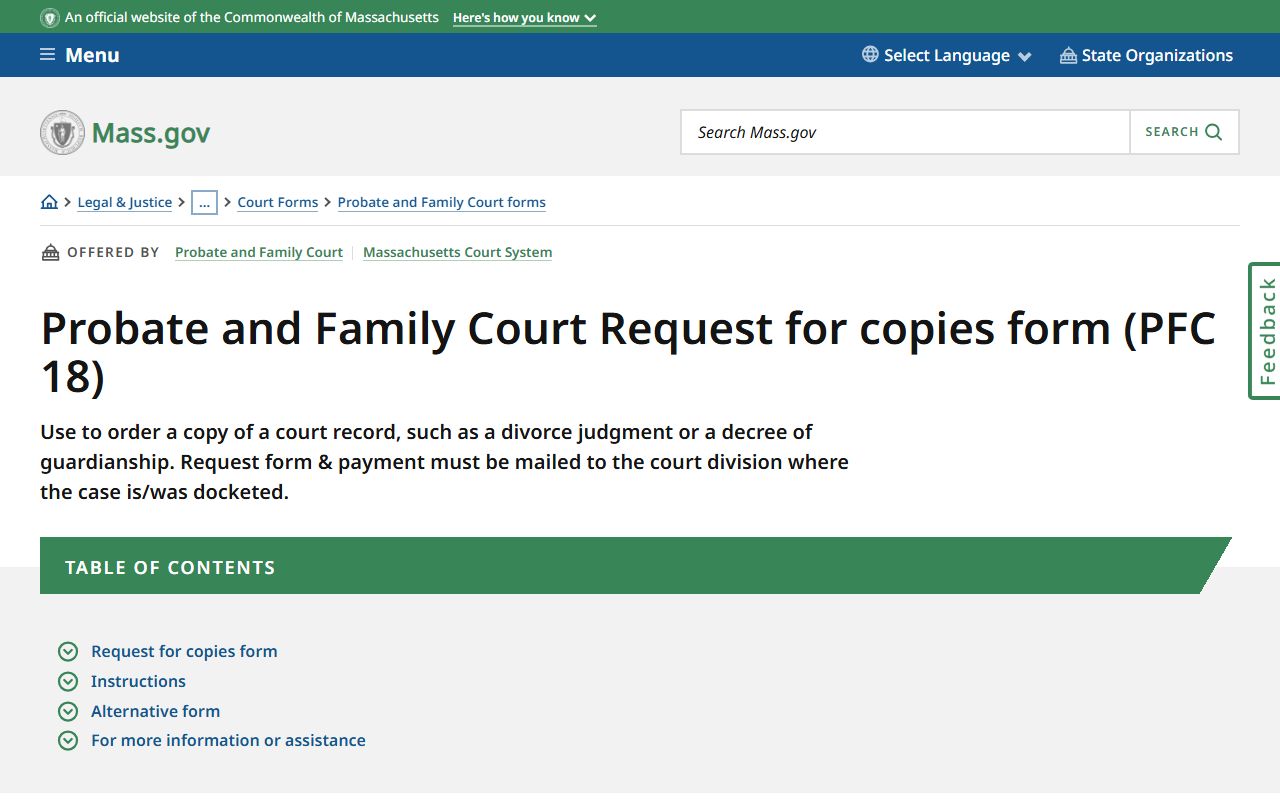
The form is free to download and submit. Fees apply to the copies themselves, not to requesting them.
Copy fees vary by document type. A Certificate of Divorce Absolute costs $20. A certified judgment of divorce nisi also runs $20. A certified copy of a separation agreement costs $20 for the first page plus five cents for each additional page. Guardianship decree copies are $22 and conservatorship decrees are $21. A Certificate of Name Change is $20. Attested copies of other court documents are $2.50 per page. Unattested plain copies are just five cents per page. Exemplified copies, which are used in courts outside Massachusetts, cost $50 plus $1 per page after the first.
The step-by-step guide for getting a court record copy walks you through the full process and links to PFC 18 and contact information for all 14 county divisions.
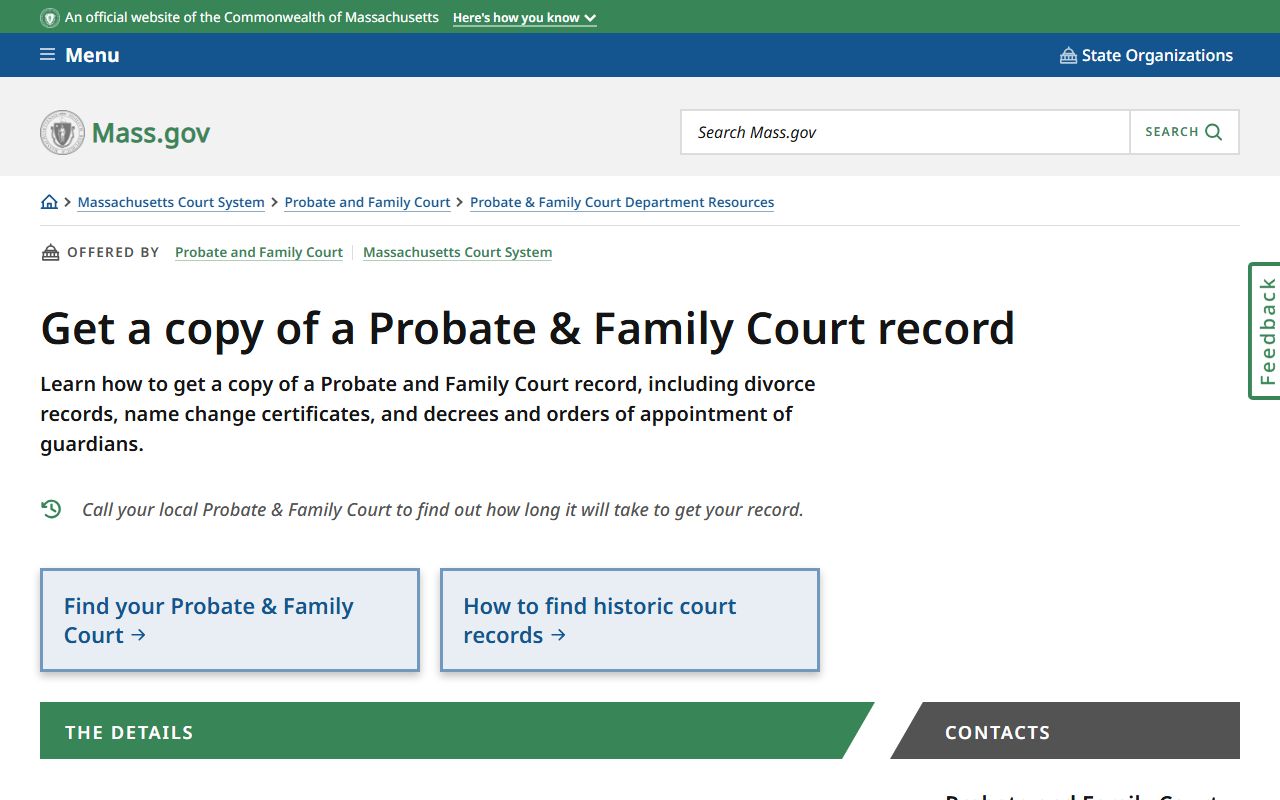
Payment for mail requests must be made by attorney's check, money order, or bank certified or cashier's check made payable to the Commonwealth of Massachusetts.
Filing Fees at Massachusetts Family Courts
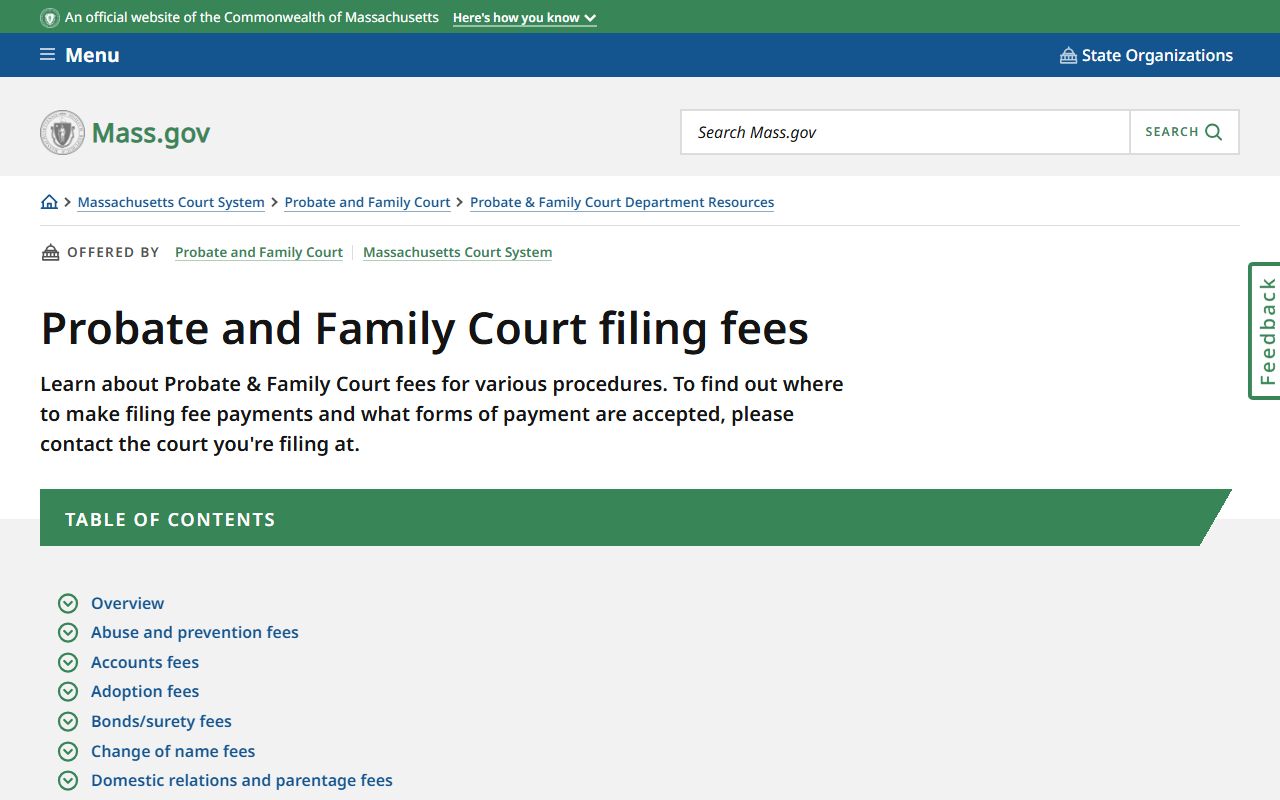
The Probate and Family Court uses one statewide fee schedule. Fees are the same at all 14 county divisions. A joint petition for divorce costs $215. A complaint for divorce costs $280. A $15 surcharge applies on top of each filing fee. A summons costs $5 and a citation is $15. Service by constable or sheriff runs about $50 to $75 extra. Name change petitions now cost $165 total, which includes the $15 surcharge, following a rule change in November 2025 that also sealed name change records by default. Guardianship petitions, estate filings, and paternity actions each have their own fee amounts listed in the full schedule.
The court filing fees page at mass.gov lists current costs for all case types handled by Massachusetts Probate and Family Courts, including divorce, guardianship, and probate matters.
Fee waivers are available for people who cannot afford to pay. File an Affidavit of Indigency with your court. The judge reviews your income and decides if you qualify. All court forms including the Affidavit of Indigency are free at mass.gov forms page.
Virtual Registry and Remote Access
Most of the 14 Probate and Family Courts now offer a Virtual Registry service. You connect with registry staff by video over Zoom during scheduled hours. This service lets you ask questions, check case status, request documents, and handle routine registry matters without coming in person. It is useful for people who live far from the courthouse or cannot take time off work for an in-person visit.
Hours vary by county. Most courts hold virtual sessions Monday through Friday, typically from 9:00 AM to 12:00 PM. Some courts offer longer windows. Worcester County runs sessions from 8:30 AM to 1:00 PM and again from 2:00 PM to 4:00 PM on weekdays. Essex County holds virtual registry all day from 8:00 AM to 4:30 PM. Suffolk County runs sessions three days a week from 8:00 AM to 1:00 PM. Each county lists its own Zoom meeting ID and call-in number on its page at mass.gov. Most courts also accept case questions by email outside of virtual hours. Sign up for hearing reminders at mass.gov eReminder to get text alerts four days and one day before your scheduled event.
Public Access Rules for Family Court Records
Most family court records in Massachusetts are open to the public. You do not need to be a party to the case to request copies. No reason is required. You can walk into any Probate and Family Court during business hours and ask to see a case file. Records at all 14 divisions follow the same general access rules.
The Probate and Family Court public records FAQ at mass.gov answers common questions about which records are open, which are restricted, and how to request copies of files you are entitled to see.
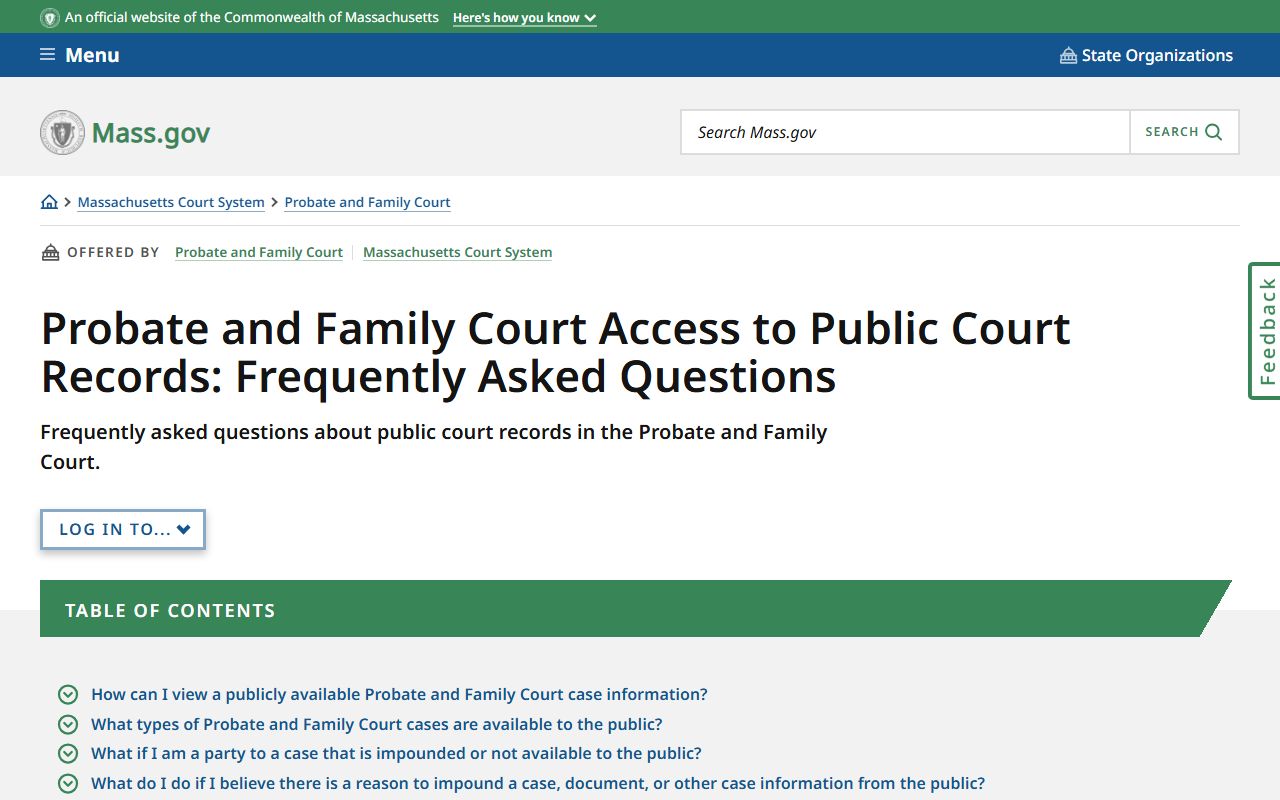
The FAQ also explains the process for seeking access to records that have been impounded or sealed by court order.
Some records are not public. Adoption files are sealed under Massachusetts law. A court order is needed to open them. Juvenile records are also closed. Financial statements filed in divorce cases may have limited public access depending on what the judge ordered in that specific case. Name change petitions filed after November 25, 2025 are now impounded by default. Abuse prevention records are available only in person at the courthouse and cannot be searched online. Guardian ad litem reports and some mental health evaluations filed with the court may be restricted as well.
If you need access to a restricted or impounded record, you must file a motion with the court and explain your reason. The judge reviews the request and decides. Court staff cannot override a judge's order. This process applies across all 14 county divisions in Massachusetts.
Free Legal Help for Massachusetts Family Court Cases
Several groups offer free or reduced-cost legal help to people dealing with family court matters in Massachusetts. Greater Boston Legal Services serves Suffolk County and surrounding areas with free legal assistance for people who qualify by income. Call (617) 371-1234 to ask about their family law services. Community Legal Aid covers Central and Western Massachusetts from its Worcester office and handles custody, support, and other family court matters for income-eligible clients. Northeast Legal Aid serves Essex County and parts of Middlesex County with similar free services.
MassLegalHelp at masslegalhelp.org provides step-by-step guides, court forms, and plain-language explanations for people who want to handle their own family court case. All official Probate and Family Court forms are available at no cost at the court forms page on mass.gov. The Massachusetts Bar Association runs a lawyer referral service at (617) 654-0400 or toll-free (866) 627-7577. The first consultation costs $25 for 30 minutes. A free Dial-A-Lawyer program runs on the first Wednesday of each month at (617) 338-0610. Many courts also run a Lawyer for the Day program at the courthouse on specific days, where you can get brief legal advice at no charge.
Browse Massachusetts Family Court Records by County
Each of the 14 counties in Massachusetts has its own Probate and Family Court. Pick a county to find local court contact info, hours, virtual registry access, and specific resources for family court records in that area.
View All 14 Massachusetts Counties
Family Court Records in Major Massachusetts Cities
City residents file family court matters at the Probate and Family Court in their county. Pick a city below to find which court serves that area and how to access records filed there.